
Stake provably fair: how results are made and checked
Every in-house game at Stake casino uses a provably fair system: the result of each round is fixed by a combination of the operator's hidden input and your own input, and after the round you can recompute it yourself. This page explains the commitment scheme behind it, what the server seed and client seed do, and how to verify a result step by step.
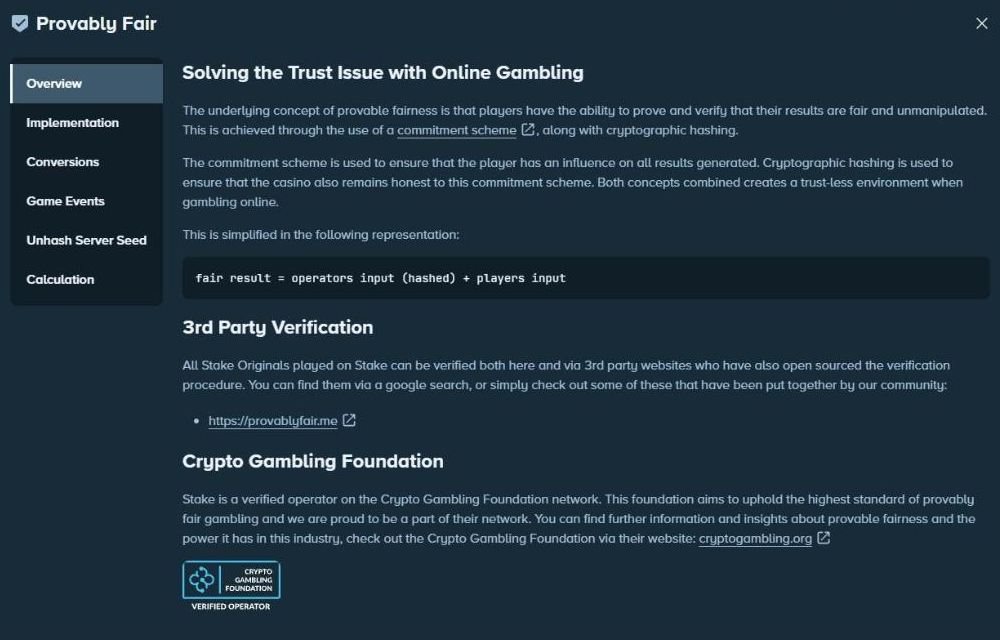
The idea behind provable fairness
In an ordinary online casino a player has to trust that the game was not adjusted after the bet. Provable fairness removes that trust problem with two tools. A commitment scheme makes sure the player influences every result, and cryptographic hashing makes sure the operator cannot change its own input once the player has seen its fingerprint. Stake sums it up in one line on its Provably Fair page:
fair result = operator's input (hashed) + player's input
The Provably Fair section on stake.com is split into Overview, Implementation, Conversions, Game Events, Unhash Server Seed and Calculation. The first explains the concept, the middle tabs show how the random numbers are turned into a card, a tile or a multiplier, and the last ones let you reveal a seed and run the maths on your own bets.
Server seed and client seed
Server seed
A secret value generated by the operator. Before you play, you only see its hash — a one-way fingerprint. The hash commits the operator to that exact seed: if the seed were swapped later, its hash would no longer match.
Client seed
A value that comes from your side and that you can change in the fairness settings. Because the result depends on it too, the operator cannot pick a server seed that produces a chosen outcome for you.
Each bet combines the two seeds with a counter for the number of bets made with that pair, so every round of Mines or Plinko gets a fresh, unpredictable result even though the seeds stay the same. When you rotate to a new seed pair, the old server seed is revealed (“unhashed”), and from that moment every past bet made with it can be checked. Crash adds a public element: the hash of the server seed is published before a round starts and the value is revealed afterwards, so all players in the multiplayer round can compare it.
How to verify a result
Open Fairness under the game
Every Stake Original has a Fairness button below the game window. It shows the active client seed, the hashed server seed and the number of bets made with the pair.
Change the client seed
Rotating the seed pair reveals the previous server seed. Copy it together with the client seed you used.
Check the hash
Hash the revealed server seed and compare it with the hash you were shown before playing. They must be identical.
Recalculate the bet
Use the Calculation tab, or an independent verifier such as provablyfair.me, with the seeds and bet number. The tool should produce the same outcome as in your bet history.
Most players never run this check, and that is fine — the point is that anyone can. If a recalculated result ever differed from the bet history, that would be clear evidence to send to live chat together with the bet ID.
Which games use it
Provable fairness covers the Stake Originals, a collection of 31 in-house games. Their published return-to-player figures make the fairness system concrete:
| Game | RTP | House edge |
|---|---|---|
| Plinko | 99% | 1% |
| Mines | 99% | 1% |
| Crash | 99% | 1% |
| Dice | 99% | 1% |
| Chicken | 98% | 2% |
| Dragon Tower | 98% | 2% |
Slots and live dealer tables from outside studios are not part of this system; they rely on the providers' certified random number generators.
What provably fair does not do
Fairness proves that a result was not manipulated; it does not remove the house edge. Over many rounds a 1% edge still means that 100,000 PKR wagered on Mines returns about 99,000 PKR on average, and a 2% edge on Chicken returns about 98,000 PKR. Short sessions swing widely in both directions, which is why a budget and loss limits matter more than any system.
It also explains why predictor apps, Telegram bots and AI hacks for Mines, Crash or Plinko cannot work. The server seed is hidden until you rotate it, every round is independent, and a 1.05x crash says nothing about the next one. Anyone selling such a tool is after your money or your login. Stake is listed as a verified operator of the Crypto Gambling Foundation, which promotes provably fair standards.
Provably fair FAQ
Which games are provably fair?
All Stake Originals, such as Plinko, Mines, Crash, Chicken, Dice and Dragon Tower. Third-party slots and live dealer games use their providers' own certified random number generators instead.
Can I change my client seed?
Yes. The client seed is the player's input to the result. Changing it starts a new seed pair, and the previous server seed can then be revealed and checked.
Does provably fair mean I will win?
No. It proves that a result was not changed after the bet. The house edge still applies — for example 1% on Plinko, Mines and Crash and 2% on Chicken and Dragon Tower.
Can I verify results outside Stake?
Yes. Results can be checked on the operator's Provably Fair pages and on independent tools such as provablyfair.me, which have open-sourced the verification procedure.
Do predictor apps work against provably fair games?
No. The server seed stays hidden until it is revealed, and each round is independent, so no app, bot or AI can know the next result in advance.